
Agritech Provence · Apt, Luberon, France
Spot it sooner,
protect the harvest.
Agritech Provence locates vine disease hotspots with a drone carrying a multispectral camera and with artificial intelligence. We fly over organic vineyards in Provence and tell winegrowers where to look. Every flight adds to an image database that learns to detect faster and better: less time lost, better protected harvests.
The drone does not replace field scouting.
It tells you where to go, and saves you time.
Winegrowers told us this summer: time is short, costs are rising, the next generation is hard to find, and the climate makes diseases harder to predict. In 30 minutes per hectare, the drone looks at the whole plot with the same attention everywhere.
Video · in French
Multispectral imaging
What the drone sees
Our drone carries two cameras. One takes colour photos, like the human eye. The other measures four bands of light, two of them invisible: red-edge and near infrared.
A healthy leaf absorbs red light for photosynthesis and strongly reflects infrared. A stressed leaf reflects more red and less infrared. The drone measures that change on every vine, across the whole plot, in a single flight.
Healthy leaf
Stressed leaf
Light reflected by the leaf, by band. Illustration, indicative values.
2026 results · Downy mildew · Marsanne plot
What the drone saw
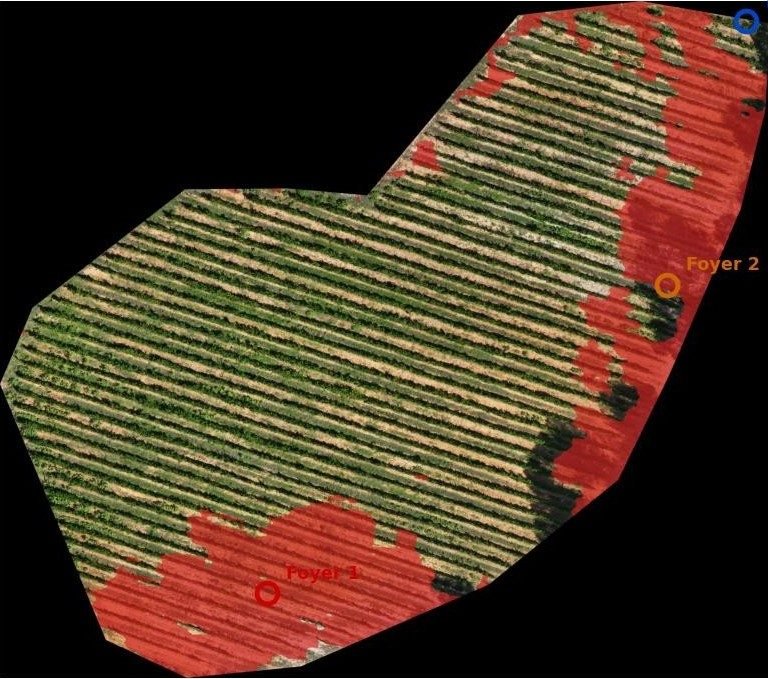
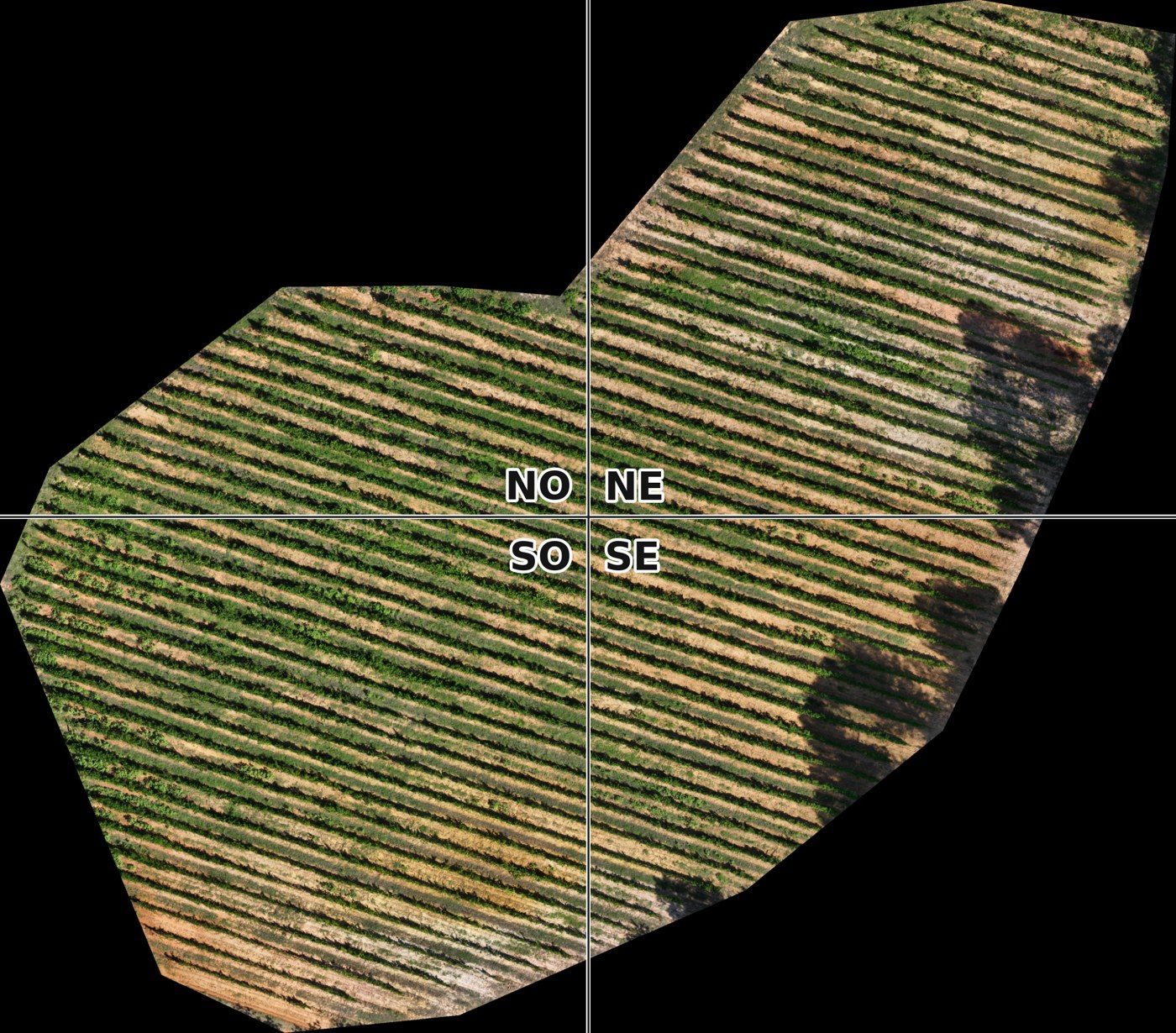
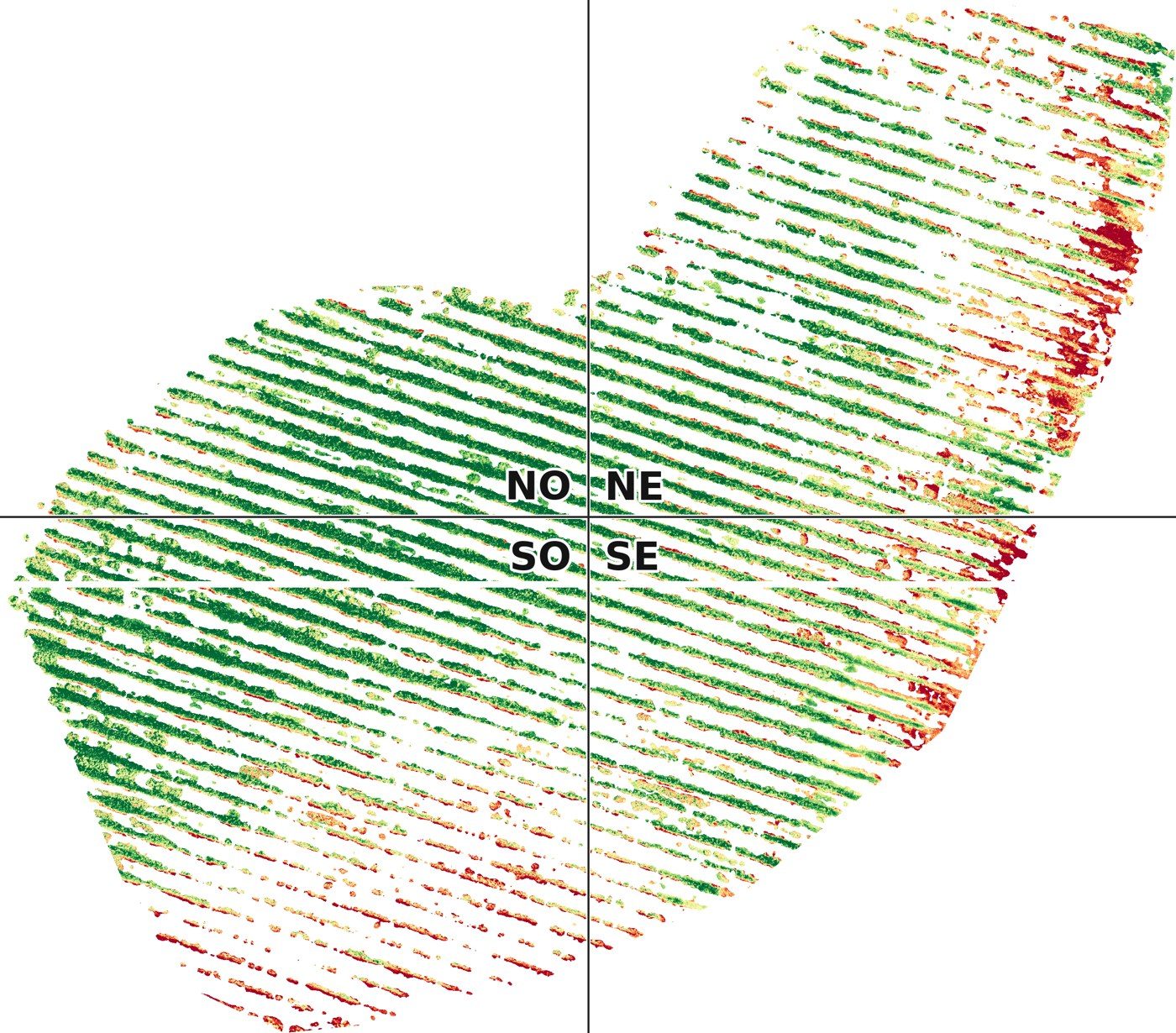
The winegrower knew there was downy mildew, but did not tell us where. The drone had to find the hotspots on its own.
Our solution
Fly, flag, check
Fly
Every plot, every month, at the same time of day and the same height. 2 cm per pixel: every vine is visible.
Flag
The camera measures the light reflected by the foliage. Artificial intelligence flags around twenty areas to inspect, ranked, with their GPS coordinates.
Check
The winegrower confirms or rules out each alert on the ground. Every check feeds the model, which gets more accurate with each flight.
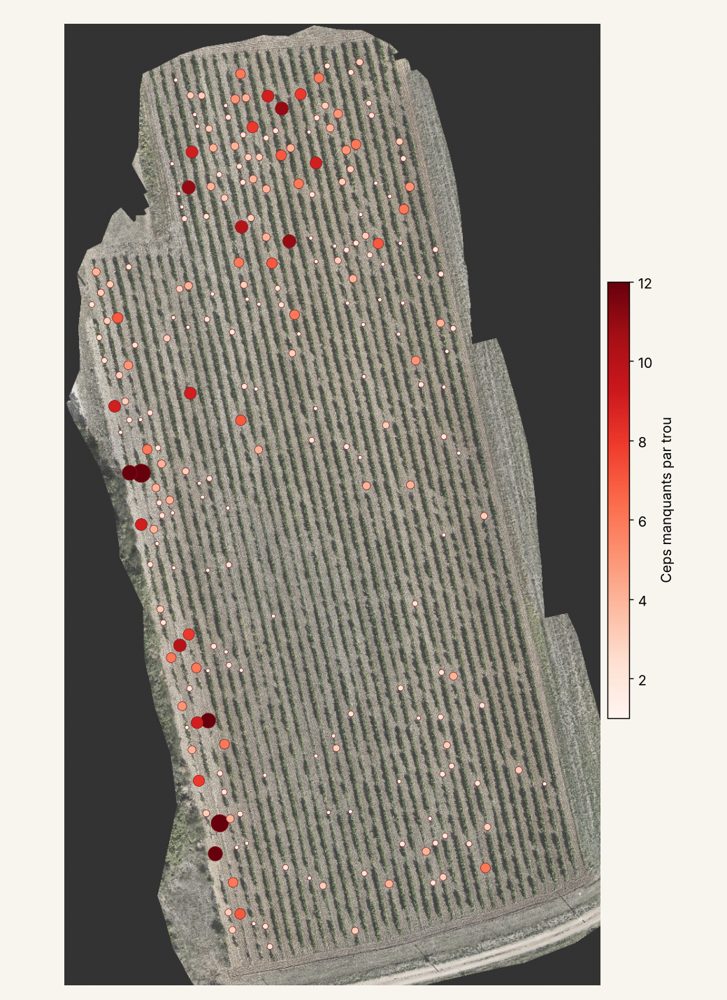
Downy mildew · Powdery mildew · Flavescence dorée · Missing vine count · See the full method
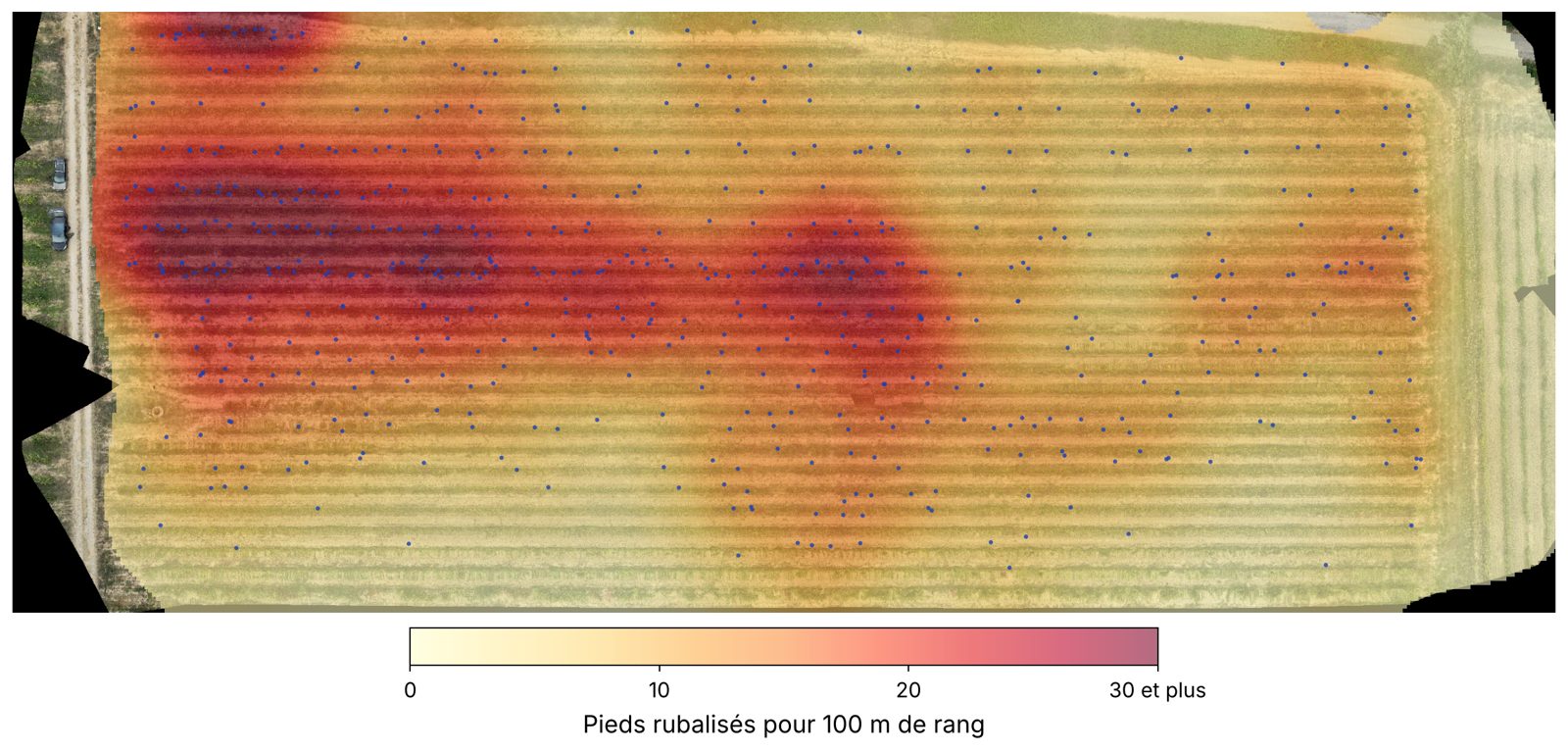
6 of the 8 areas flagged by the drone before field scouting had a higher density of affected vines than the plot average. The drone finds where the disease is concentrated, not yet every single vine.
The drone also tells you where not to go
10 / 16plots monitored for downy and powdery mildew showed no major problem. Less than 1 ha to inspect as a priority, out of about 21 ha flown over.
Elsewhere in the world
Farm drones are already at work
In Asia and the Americas, drones already treat millions of hectares. In France, the door is only just opening.
treated by drone in more than 100 countries, cumulative, according to DJI (2025).
DJI agricultural drones in use at the end of 2024, up 90% since 2020.
China carried out about 203 million hectares of drone treatments in 2025, thirty times more than the United States.
Aerial spraying is banned in principle. The law of 23 April 2025 opens it to a few cases: slopes of 20% or more, organic, biocontrol or low-risk products.
Sources: DJI Agriculture, 2025 annual report; CleanTechnica, September 2026; Réussir, April 2026.
Collective intelligence
One grower's weak spot becomes everyone's strength.
Every plot flown over and every vine checked on the ground improve a model that benefits all the winegrowers in the region. Each estate keeps its own data, and published results are always anonymised.
Join the 2027 season
About
Born in Provence, rooted in the vineyards
The granddaughter of farmers, Julie Demarigny spent twenty years in digital transformation, from Warner Bros. to Los Angeles. Back in Provence, she founded Agritech Provence in Apt in January 2026. A drone pilot herself, she flies every plot in person.
Recognised in 2026
 101 Femmes EntrepreneuresLaureate for the Vaucluse · Bpifrance and the French Ministry for Equality
 Be a Boss Women TourWinner for the Sud region · national finalist
With the support of Bpifrance, Initiative Terres de Vaucluse and Force Femmes. Awards and support
Press
In the media
Let's talk about your vineyards
Winegrower, journalist, institution, researcher or partner: we reply within 48 hours, in English or French.